Built on the factory floor. Not in a software office
PackGuru was built by people who spent years maintaining and improving the machines your operators run every day. That produced a kind of knowledge no software company can buy — and it changes what you should demand from any system you put on your line
Ten years on the line, condensed
Each one took real breakdowns to learn. Each one is also a question worth asking any vendor who says "AI for manufacturing"
When Robot 2 and 3 absorb load from Robot 1, it's a vacuum leak — not a sensor fault
The failing robot doesn't alarm. It just slows, and its neighbours quietly pick up the work. Generic monitoring sees "all robots running". Someone who has replaced those hoses sees a leak with weeks of warning.
Foam interlayers from closure boxes clog vacuum pumps gradually — with no visible signal
No sensor watches for foam dust. The pump degrades over weeks, then a full stop lands mid-shift. The only early evidence is a pattern in pick-time data that you recognise only if you know what caused it last time.
A cap-sorter spring dies by cycle count, not by calendar
Service plans say "quarterly". The spring says "every N million cycles" — and a high-SKU line hits N at unpredictable dates. One spring replaced before failure saves more than 6,000 bottles. Replaced after, it costs a shift.
The line ran perfectly on Friday. It's underperforming today. Something changed — find it
Ninety-nine times out of a hundred it's a parameter: a setpoint nudged during a night shift, a recipe loaded for the wrong SKU variant. The fix isn't diagnostics — it's a diff against the last known-good configuration.
Operators don't read manuals. They watch the person next to them — or a video
Every binder on the line is pristine because nobody opens it. Knowledge actually moves by demonstration. If the system's answer to a stuck operator is a PDF, the system will not be used after week two.
Declared changeover: 30 minutes. Measured: 47
Nobody is lying — the paper form starts when the operator remembers to start it. Machine signals don't forget. The 17-minute gap, times three changeovers a day, is a hidden line's worth of capacity across a plant.
The factory that lets a vendor open inbound firewall ports has bigger problems than downtime
Production networks are attacked through exactly this door. Data can leave a factory through a one-way DMZ bridge on port 443 — nothing has to come back in. Any architecture that needs more is a risk transferred to you.
The biggest loss on a cosmetics line has no alarm code at all
Breakdowns get meetings. Speed loss gets nothing — 17 quiet minutes per running hour of micro-stops, slow ramp-ups after changeover, lines pacing themselves down around a struggling module. It's the largest single loss and the least measured.
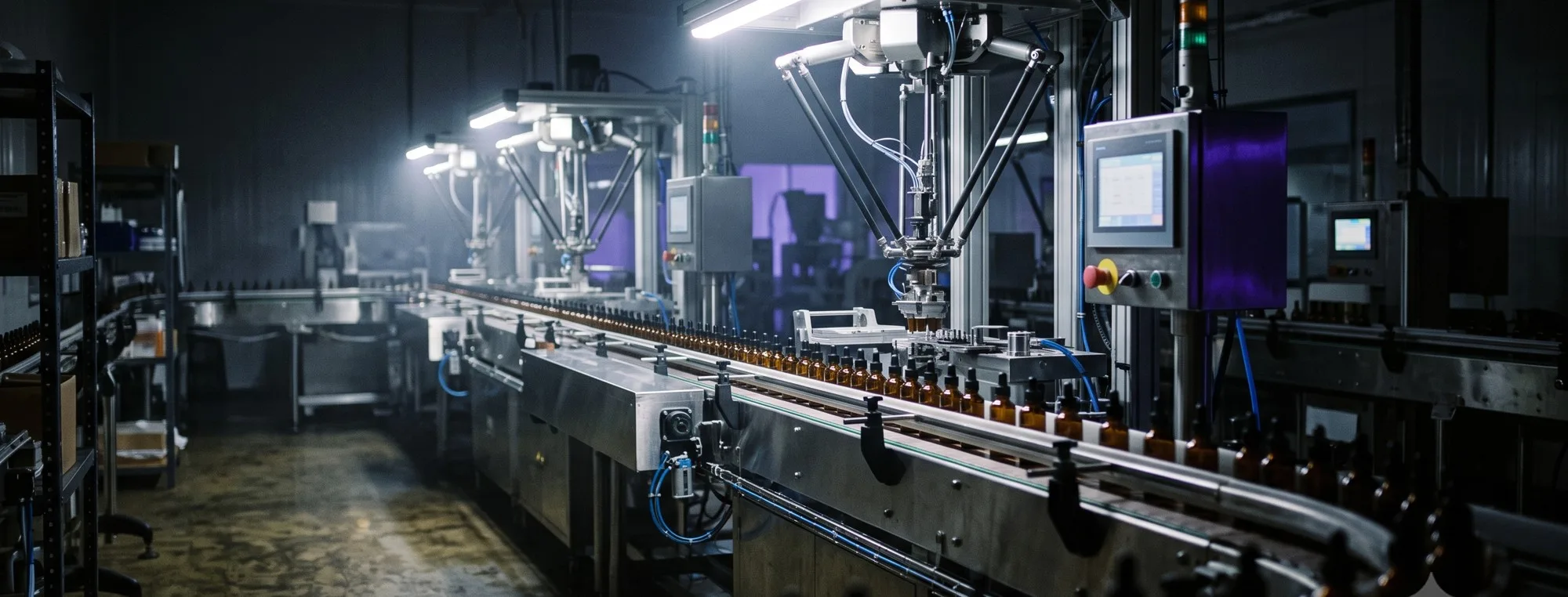
That knowledge took years of deployments to accumulate. No software company can buy it
PackGuru doesn't monitor generic "machine signals". It knows what a vacuum pump failure looks like before your sensors do — because the people who built it spent a decade fixing the machines it now watches. Every deployment adds machine-level patterns no competitor sitting in a software office can replicate
Bring these eight questions to any vendor. Including us
We'll answer all eight on your line, with your machines' data.